
Our class has just finished Unbroken by Laura Hillenbrand. What a book! The author's thorough and vast research, as well as Louis Zamperini's extraordinary life, allowed her biographical novel to read as a fiction novel. A noteworthy scene in the narration involves a radio broadcast, Postman Calls, that alerts Louis' family to his survival. Today I will synthesize technology with my ISP topic and explore how the magic box of a radio transmits and receives signals between continents.

The radio developed in the late 1800's and increased in popularity soon after. Its wireless capabilities captivated the populace and is based on the use of electromagnetic energy, more specifically the radio wave. A wave always has two characteristics: frequency and amplitude. These two are essential to the system of radio stations.
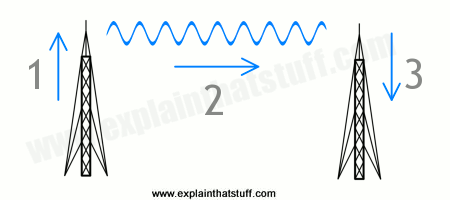
A transmitter sends out the wireless signal which travels until it is picked up by the receiver. Both sides use an antenna to do this.
How do simple waves transmit beautiful voices and powerful messages? Radio stations use either amplitude modulation or frequency modulation to encode their content.

Amplitude modulation occurs when you overlay the information by manipulating the amplitude (height) of your output wave. High points in your information wave would correspond with areas of large amplitude.

Frequency modulation is slightly more complex but much more ubiquitous. High points in the information wave correspond with areas of large amplitude. These occur when the output wave seems "squished together".
Learning and researching about how radios work has been a real joy because I had no idea how such a common object worked. I am now seriously considering build a personal radio transmitter...
Works Cited:
Brain, Marshall. "How Radio Works." HowStuffWorks. N.p., 07 Dec. 2000. Web. 08 Feb. 2016.
Woodford, Chris. "Radio." Explain That Stuff! N.p., 5 Sept. 2015. Web. 08 Feb. 2016.

No comments:
Post a Comment