Thursday, December 10, 2015

Noise Pollution?!

In October, I learned of a cool opportunity with NASA that culminates in a summer week-long trip to the Johnson Space Center: the High School Aerospace Scholars program. I promptly applied and waited with bated breath. Upon learning of my acceptance, I had a brief moment of celebration until I realized I would need to complete extra online assignments through spring. ~~Conclude backstory~~


Through an online course I am taking on aerospace topics, I learned of noise pollution and the ways NASA is addressing it. Noise always surrounds me, and I have never thought of it as pollution. However, loud sounds from airports, traffic, and construction sites are real issues that causes hearing damage to many. 


My course primarily addressed the airport aspect of the issue, and offered a quieter alternative to the traditional tube-and-wing design of aircraft that is used on practically every aircraft today. Its use for decades stems from its relative simplicity, efficiency, and ease of design. However, NASA researchers have developed a new design, the blended-wing-body (BWB) design that promises better efficiency, lower noise production, and increased safety. This design works by creating more lift with less drag with its combined body and wing, resulting in less fuel burn and less noise production.


This development could prove to alleviate headaches for residents near airports, as well as significantly boosting the cool-ness factor of flying.


Sources:
NASA 360. "NASA Aviation Technology." YouTube. YouTube, 04 Feb. 2015. Web. 10 Dec. 2015.

How to get rid of ... sound?!

In the spirit of the holiday season, I was browsing those great Cyber Monday deals the weekend of Black Friday and came across a great looking pair of fancy "noise-cancelling" headphones.


http://www.amazon.com/Bose-QuietComfort-Acoustic-Cancelling-Headphones/dp/B00M1NEUA0/ref=sr_1_1?ie=UTF8&qid=1449696020&sr=8-1-spons&keywords=noise+cancelling+headphones&psc=1


I've tried noise-cancellation before at various stores and can attest to their effectiveness. However, how does this technology work? You can't just swat sound waves out of the air. Turns out, you actually use sound's nature as a wave against them!

Let me ask you a simple question: What is sinΘ - sinΘ ? You don't need to know trigonometry or calculus to know that anything minus itself is zero. When talking about noise cancellation, that zero means a quiet listening experience!

Waves can be mathematically represented using sine or cosine, and when two waves meet, the result is their sum. Say that one wave can be represented with sinΘ and another wave is represented by
-sinΘ. When they meet, the result is sinΘ + (-sinΘ) = 0. This process, called complete destructive interference, results in both waves cancelling each other out and a heightened enjoyment of the sounds you actually want to hear!


Sources:
Harris, William. "How Noise-canceling Headphones Work." HowStuffWorks. N.p., 14 Feb. 2007. Web. 10 Dec. 2015.

Sunday, November 15, 2015

Sound and Manipulation

Even though we've only read an act of Othello so far, everyone can tell that Iago is a big jerk master of deception.  Similarly, auditory illusions can fool even the greatest of us. Many of these illusions exist (enough to constitute a Wikipedia page?!) but I will only be covering the two coolest ones I found

Tritone paradox

This illusion occurs when you are presented with a series of two successive notes, and are told to decide whether the pattern is ascending or descending between each pair. Try it yourself! (and record your answers): 


I hear: 1) ascending 2) ascending 3) ascending 4) descending. It's probably different for you.
This illusion works because each pair of tones actually diverges by an octave (same note, about a 12-year old's hand apart on the piano) and whichever tone you perceive is based wholly on your unique brain. 

Shepard tone illusion

I've heard this illusion many times, but it never loses its wonder. 


Whenever I listen, I get nervous as the pitch rises and rises, and I move to take off my earbuds before my ears explode. However, the moment never arrives and yet the pitch continues to rise. This illusion does consist of rising pitches, so we are somewhat sane. However, the trick (and what we don't perceive) is that whenever a pitch reaches a certain point, it drops backs down a couple octaves and restarts its endless cycle. This is similar to a barber pole that seems to rise up forever but never move an inch. 


Sources:
"Tritone Paradox." Wikipedia. Wikimedia Foundation, 19 June 2015. Web. 16 Nov. 2015.

Pop!♫

Grandparents watch the music video on YouTube with horrified revulsion. Kids download the mp3 and listen to it almost religiously. Yes, we're talking about pop music. 


Pop music originally derived from rock 'n' roll in the 1950s, but now has absorbed influences from many other genres. It has received vocal harmony from gospel and soul music; orchestration from classical; instrumentation from jazz, country, and rock; rhythm from hip-hop; and spoken passages from rap. 


A common method employed by pop song writers to create successful earworms is the hook. The hook is a short musical riff that draws the listener into the song and is very memorable. Often the hook is found in the chorus, such as in the following link:


Sometimes the hook is actually in the intro:


As a person who listens to classical and Christian music, I can't say I personally enjoy pop music. However, it has had a tremendous impact on current culture, and thus cannot be ignored. Also, if I were being honest, it is pretty catchy.


Sources:
Cole, Tom. "You Ask, We Answer: What's A Hook?" NPR. NPR, 15 Oct. 2015. Web. 16 Nov. 2015.
"Pop Music." Wikipedia. Wikimedia Foundation, 12 Nov. 2015. Web. 16 Nov. 2015.

Thursday, October 22, 2015

He (and SF6)

As the video demonstrates, the amusement potential of helium remains undiscovered within the latex of the pretty balloons at your little sister's birthday. The symbol "He" might as well stand for "Hours of Entertainment". But how does this rising gas bring your voice along for the ride?


The essential characteristic of helium that enables this effect is its lower density, specifically compared to that of normal air. Imagine bringing an empty, sealed water bottle to the bottom of a pool. Intuitively, we all know that the bottle will rapidly rise to the surface. This is because the bottle weighs less than the medium (water in this case) that the bottle has displaced, or taken the place of. Similarly, helium is less dense than plain air and therefore weighs less than it in the same area, causing the balloon to experience buoyancy, albeit in a medium of air.


Another result of lower density, apart from floating felines, is the way in which sound moves through it. The speed of sound varies with the square root of the density of the gas. In layman's terms, the denser the gas, the slower the sound. In helium, sound moves 2.7 times as fast as in plain air, and with sulfur hexafluoride 0.44 times as fast. With a faster speed comes a higher frequency and pitch, and vice versa. 


In honor of The Martian, I found that the composition of Mars' atmosphere is mostly carbon dioxide, which is denser than "Earth air". That would mean that if I somehow breathed the poisonous air and lived, I would speak in a lower pitch. Cool, huh?

Sources:

Landsberg, Randy. "Balloon Laboratory." (2002): n. pag. Kavli Institute for Cosmological Research. University of Chicago. Web. 22 Oct. 2015.

Sprott, Clint. "Sound." Sprott's Gateway. University of Wisconsin - Madison, n.d. Web. 22 Oct. 2015.

Your Voice on Mars. Perf. Dr. Bruce Betts. The Planetary Society. N.p., 23 Oct. 2014. Web. 26 Oct. 2015.

Tuesday, October 20, 2015

Good Vibes

Even prior to the annual science units on the moon phases, the identity of sound as a wave has been ingrained into every child's grey matter. Sound is a wave. Sound is a wave. Sound is a ...wait, what's a wave?


The ripples of a pond disturbed by a pebble are an example of waves. The oscillating rope below is an example of a wave. A wave is an energy-transferring disturbance in a medium, or the substance through which the wave moves. For instance, in the first example the disturbance is the rippling of the water surface and the medium is the water.


To no one's surprise, a dichotomy between types of waves exists. A sound wave would be classified as a mechanical wave, in which the particles of the medium experience motion. This is in contrast to an electromagnetic wave which requires no medium and deals with light, not sound, so we shall pay it no more heed.


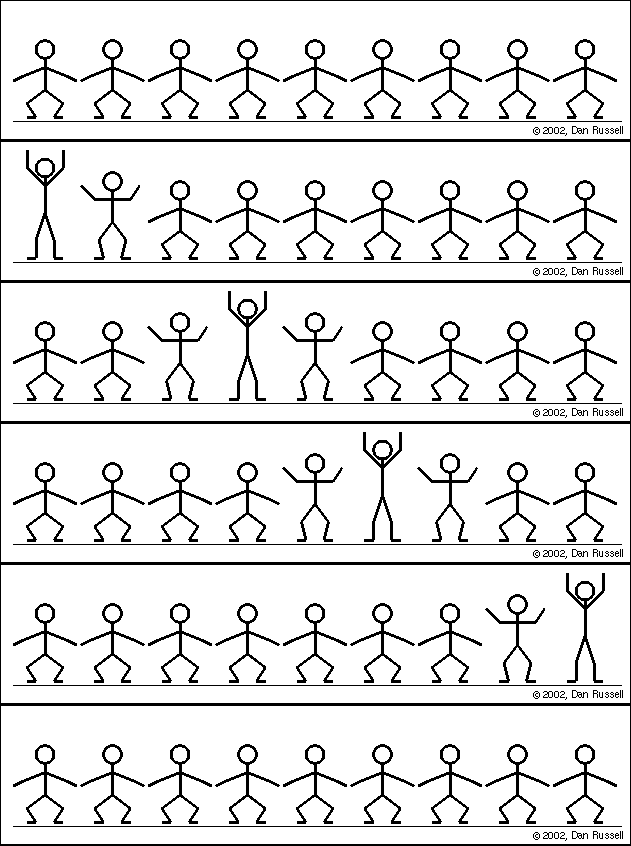
Furthermore, a sound wave is further categorized as a longitudinal wave, as opposed to a transverse wave. A transverse wave is one in which the particles of the medium move perpendicular to the direction of the wave. Since a picture is worth about $300 million, a graphic is probably appropriate.

As you can see in the above GIF, the motion of the wave is quite apparently moving to the right. However, the individual components of the medium (people) are moving vertically. The water ripples and the twanged rope are both examples of transverse waves.


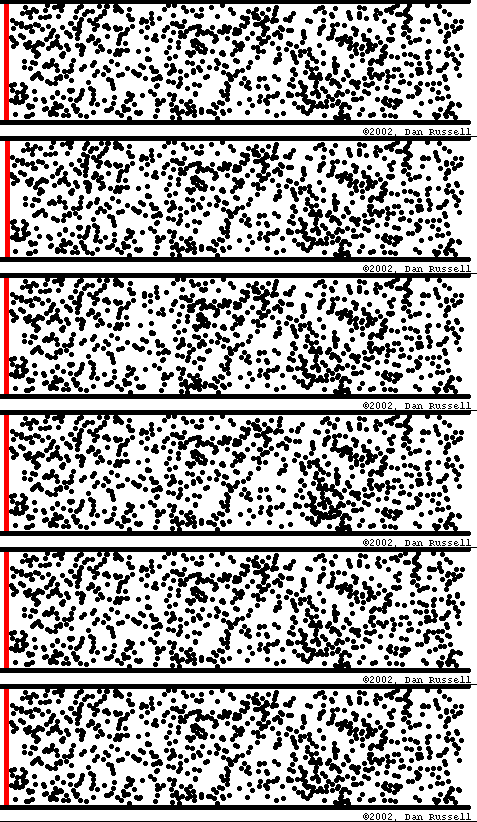
However, sound is not a transverse wave but a longitudinal wave in which the particles of the medium travel parallel to the wave's motion. Cue another fabulous visual by Daniel A. Russell.


Similar to the "people-wave", the motion of this wave is to the right. Unlike the previous wave, however, the motion of each individual particle is side-to-side (parallel to the motion of the wave!). Applying this model to sound, we can imagine all the black specks as various molecules in the air. The red bar on the left is a speaker which compresses the air, creating a disturbance that is propagated through the medium. This disturbance eventually reaches our eardrums, where it is captured (much like a wild gazelle) and sent to the brain to be analyzed. Therefore, sound is simply a transmitted vibration of the air.


Sources:
Knight, Randall Dewey, Brian Jones, and Stuart Field. "Traveling Waves and Sound." College Physics: A Strategic Approach. 3rd ed. N.p.: Pearson Education, n.d. N. pag. Print.

Russell, Daniel A. Multiple Wave GIFs. Digital image. Acoustics and Vibration Animations. N.p., 18 Feb. 2015. Web. 20 Oct. 2015.

"What Is a Wave?" What Is a Wave? The Physics Classroom, n.d. Web. 20 Oct. 2015.